Tuesday, 18 December 2018

Gwlad yr Iâ / Iceland

Scroll down for English.


Cymraeg

Yng nghanol mis Hydref, treuliodd Mel a fi wythnos yng Ngwlad y Iâ. Hedfanon ni o Gatwick ac roedd yr hedfan yn brofiad diddorol. Hedfanon ni ar hyd y Deyrnas Unedig, uwchben awyr glir, dros Ynys Skye ac Ynysoedd Allanol Heledd. Ar uchder o 11Km dros Glasgow, gwelon ni bod y wlad yn gul iawn yn y gogledd. Ro’n ni’n gallu gweld yr Afon Forth a Môr y Gogledd trwy’r ffenestri ar y dde, a Chefnfor yr Iwerydd ar y chwith.

Cyrhaeddon ni Keflavik yn y glaw, yng nghanol y prynhawn. Ar ôl casglu ein bag a’r car llogi, roedd rhaid i ni wneud tipyn bach o siopa – bwyd a thanwydd ar gyfer ein stôfau gwersylla. Gwnes i ymchwilio cyn gadael cartef, a chredais i bod poteli nwy, a thanwydd Coleman ar gael mewn gorsafoedd petrol. Yn anffodus, doedd dim un o’r ddau ar gael mewn gorsaf betrol. Yn ffodus, gwelon ni botel o “lampa olía” (cerosin), a oedd yn addas. Yn y pen draw, doedd dim rhaid i ni boeni, achos yng ngwersyll Grindavik, roedd cwpwrdd mawr yn hanner llawn o boteli nwy, yn rhad ac am ddim.

Gaethon ni bryd o fwyd hyfryd hyfryd o dorgoch gyda saws cimwch mewn bwyty o’r enw Ráin, ac yna gyrron ni dipyn bach yn ofnus i Grindavik. Yn y dyfodol, dylwn ni gofio peidio â gyrru mewn gwlad dramor am y tro cyntaf yn y tywyllwch!

Dydd Sul

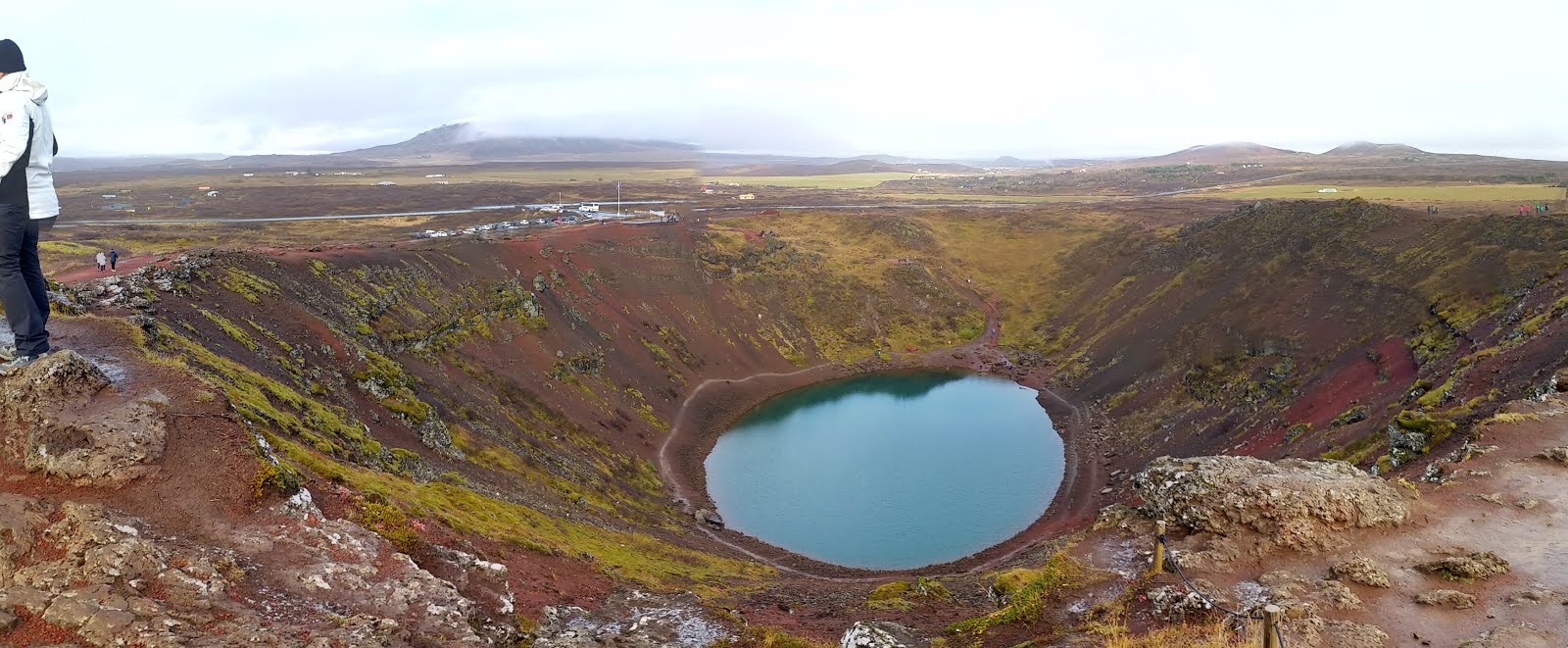
Dihunon ni fore Sul yng ngwersyll Grindavik a phacion cyn mynd i Geysir. Ar y ffordd, gwelon ni ceudwll folcanig yn Kerið. Maen nhw credu bod y ceudwll yn ffurfio pan bod cerrig o’r wyneb yn cwympo i mewn i siambr magma’r llosgfynydd. Mae llyn afloyw ar waelod y ceudwll a llawer o adar adeingoch dof o gwmpas.
Yn Geysir, mae siopau â llawer o feysydd parcio. Cerddon ni o gwmpas y ffynhonnau poeth, gyda nentydd o ddŵr yn llifo dros y tir. Cyn bo hir, cyrhaeddon ni geiser Strokkur, sy’n echdorri pob 5-10 munudau. Pob 20 metr mae jet uchel o ddŵr poeth yn echdorri, ac yn llifo dros y llwybr, gan adael haen o fwynau. Roedd y ffynhonnau mawr poeth â mwynau o’u cwmpas nhw, ac aethon ni lan y bryn am olygfa o’r holl le.

Yn wreiddiol, ro’n ni wedi cynllunio i wersylla yn Hveravellir, yn yr ucheldir. Ro’n ni credu bod yr heol (F35) fel arfer ar gau ar ddiwedd mis Hydref. Ond roedd yr heolydd wedi cau am sawl wythnos, achos yr eira a gwersyllon ni yn Sjkól, ar bwys Geysir.

Ar ôl gosod y babell, ymwelon ni â rhaeadr Gullfoss. Mae grisiau enfawr o rhaeadrau yno. Roedd arwydd ar y llwybr yn argymell defnyddio cramponau, ond roedd pawb yn ei anwybyddu. Ffeindion ni ddim iâ ar y llwybr, ond roedd chwistrell o’r rhaeadrau, yn rhewi ar lannau’r afon.

Tra ro’n ni’n coginio swper, roedd Mel yn meddwl ei bod hi yn gallu gweld golau glaswyrdd yn y awyr. Wedyn ar ôl iddi hi dywyllu, gwelon ni’r Aurora Borealis yn dawnsio ar draws yr wybren. Roedd y golau’n eithaf gloyw ac yn gwneud symudiadau cyflym o gwmpas yr awyr.

Roedd hi’n noson dawel ac oer, a’r tir wedi rhewi. Roedd dillad isaf thermol, a bagiau cysgu draenblu gyda ni, ond berwon ni ddŵr a llenwon ni boteli poeth, cyn mynd i’r gwely.

Dydd Llun

Cysgon ni yn weddol dros nos, ond roedd fy mat aeri yn gollwng. Ro’n i’n cysgu ar fatiau aer ⅔ydd o’u hyd, ar ben matiau ewyn hyd llawn. Roedd e’n anghysurus cysgu ar y mat ewyn un unig. Gwnes i geisio ei drwsio fe, ond do’n i ddim yn gallu ei wneud yn iawn.

Trannoeth, roedd hi’n oer iawn. Ar ôl i ni orffen ein paned o de, roedd y llaeth oedd dros ben wedi rhewi yn ein bowlenni brecwast.

Aethon ni i Þingvellir, lle ‘r oedd hen senedd Gwlad yr Iâ. Mae Þingvellir yn ddyffryn hollt, gyda plât cyfandirol Gogledd America i’r gorllewin, a Eurasia i’r dwyrain. Mae’r platiau yn symud ar wahân tua 2cm pob blwyddyn. Cerddon ni i Sgógarhóll, a chroesi’r llwybr lle’r oedd sawl bwlch dwfn wedi llenwi â dŵr. Ro’n nhw wedi agor achos y drifft cyfandirol, yn amlwg. Dilynon ni Grugiar yr Alban ar hyd y llwybr, cyn iddi hi hedfan bant. Wedyn cyrhaeddon ni Sgógarhóll. Dyma fan yng nghanol unman lle’r oedd sawl llwybr yn cwrdd, ond yn anffodus, doedd dim amser i gerdded ymhellach.

Gorffennon ni’r dydd gyda dip yn y Lagŵn Dirgel, ffynnon boeth yn Fluðir, cyn mynd yn ôl i’r babell i goginio. Dyw y Lagŵn Dirgel ddim yn gyfrinach,. Pris mynediad oedd £20 (£16 i ni achos rhoddodd y gwersyll yn Sjkól ostyngiad o 20% i ni). Pwll nofio yw e gyda ochrau o garreg a llawr graean. Mae e’n cael ei fwydo gan ffynhonnau bach, poeth iawn, o’i amgylch. Rhaid bod yn ofalus achos mae’r dŵr yn boeth iawn erbyn iddo gyrraedd y pwll.

Roedd hi’n gymylog yn Sjkól, felly do’n ni ddim yn gallu gweld yr Aurora.

Dydd Mawrth

Do’n ni ddim yn gallu gwersylla yn yr ucheldir achos roedd yr heolydd wedi cau, felly penderfynon ni gerdded yn yr ucheldir. Roedd yr heolydd yn eithaf clir, a meddylion ni bod yr awdurdodau wedi bod tipyn bach yn oreiddgar. ‘Sen ni wedi bod yn y Deyrnas Unedig, bydden ni wedi anwybyddu’ rhybudd. Gwnaeth “superjeeps” ein pasio ni – ceir mawr gyda teiars mawr, a bwsys arbennig gyda teiars enfawr. Parcion ni ble mae’r F35 yn mynd yn heol graen, a cherddon ni ar lwybr y ceffylau.

Roedd hi’n braf a hyfryd, gyda gwynt oer a cwpwl o centimetrau o eira ar y llawr. Aeth y gwynt yn llai pan o’n ni mynd i lawr o’r heol ac roedd cerdded yn ddymunol. Ro’n ni yng nghanol cefn gwlad, gyda mynyddoedd gwyn ag eira arnynt o’n cwmpas.  Meddyliais i y byddwn i’n hoffi teithio dros y mynyddoedd ar sgis, ond dywedodd Mel fy mod i’n hollol dwp!

Yn anfoddus, do’n ni ddim wedi mynd yn bell cyn ffeindion ni afon heb bont. Doedd Mel ddim yn hoffi’r syniad o dynnu ei hesgidiau hi bant a chroesi afon rhewlifol yn ei thraed noeth, felly cerddon ni ar hyd y glannau dipyn bach, i ffeindio lle i groesi. Yn y gorffennol, cerddais i ar draws yr afon â thraed noeth, rhoi fy mag a f’esgidiau ar lan y afon, cyn mynd nôl i gario Mel ar draws.

Ffeindion ni draciau cïol yn y eira – blaidd efallai, ac arwyddion sgyffl rhyngddo ag aderyn roedd e wedi ei ddal am ginio. Wedyn, ffeindion ni afon arall oedd yn fwy ond penderfynon ni droi’n ôl a mynd i’r car. Gorffennon ni’r dydd drwy gerdded ar hyd traciau bach yn Geysir i’r capel bach yn Haukadalskirkja.

Dydd Mercher

Dihunon ni i weld bod yr iâ yn dechrau meirioli, ac roedd y tywydd wedi troi’n eithaf gwlyb. Pan doedd dim rhew, roedd y llawr o dan y babell yn bwllyn!! Pacion ni ein pabell wlyb a gyrron ni i Reykjadalur. Pan cyrraeddon ni, roedd y tywydd yn braf. Mae hi’n daith o ryw 50 munud, a phasion ni ffynhonnau poeth, cyn cyrraedd yr afon thermol. Dyw yr afon ddim yn ddwfn, ond roedd cerrig wedi eu gosod i ffurfio cronfeydd bach lle ro’n ni’n gallu gorwedd. Mae bwrdd cerdded ar lan yr afon, a cwpl o sgriniau gwynt i gael newid tu ôl iddyn nhw. Yn yr awyr oer, ro’n ni’n newid mewn i ddillad nofio a mynd mewn i’r dŵr ar frys. Roedd y dŵr o dymheredd cyffyrddus ar gyfer arnofio a gweld y mynyddoedd eira o’n cwmpas ni.

Roedd y Lagŵn Dirgel yn neis, ond dw i’n meddwl bod yr afon thermol yn Reykjadalur mewn gwell amgylchedd, a dim yn unig achos ei fod e’n rhad ac am ddim!

Ar ôl arnofio yn y dŵr am awr, aethon ni nôl i’r car a parheuon ni ar ein taith nôl i Grindavik. Pan cyrraeddon ni, roedd y tywydd yn stormus iawn. Ro’n ni wedi cadw bwrdd mewn tŷ bwyta ym mhwll thermol y Blue Lagoon, felly aethon ni am ein swper. Roedd e’n neis, ond dim cystal â’r swper gaethon ni yn Keflavik ar y noson gyntaf. Roedd y Blue Lagoon yn neis iawn, a treulion ni tua awr yn arnofio yn ei ddŵr cymylog – mae e’n ddrud, ond mae en’ werth gwneud unwaith. Mae bar wrth y pwll ble wyt ti gallu prynu diodydd. Tipyn bach o gimmic yw e! Ar ôl i fi brynu fy niod, roedd rhaid i fi benderfynu sut i arnofio heb ei ollwng e yn y dŵr!

Roedd y gwynt yn gryf iawn yn Grindavik, a dihunon ni sawl gwaith yn ystod y nos pan chwythai’r gwynt yn gryf a gwastadu ein pabell cromen fach.

Dydd Iau

Mae ystafell gyffredin dan dô yng ngwersyll Grindavik, yn cynnwys gwresogydd a chegin. Mae hi ar agor rhwng 08:00 a 22:00 pob dydd. Roedd y gwynt yn gryf o hyd, felly gaethon ni frecwast yn yr ystafell.

Gadawon ni am ddiwrnod yn Reykavik. Dw i ddim yn “berson tref”, a gwnaeth y lle ddim creu argraff dda arna i. Doedd y siopau ddim yn ddiddorol iawn a do’n ni ddim yn gallu ffeindio rhywle da am ginio. Roedd tai bwyta yn iawn os o’t ti eisiau pryd o fwyd mawr (a drud), ond doedd dim caffes i brynu brechdanau, ayb.

Ond ro’dd y Tŷ Llosgfynydd yn ddiddorol iawn. Mae cwpl o ffilmiau byr gyda nhw, un am echdoriad yn Vestmannæyjar yn 1973, ac un arall ar y echdoriad Eyjafjallajökull yn 2010. Mae arddangosfa o wahanol fathau o greigiau hefyd.

Roedd ein pabell yn sefyll yn iawn ar ôl i ni gyrraedd nôl yn Grindavik a choginion ni swper yn yr ystafell gyffredin. Gwnaeth y gwynt barhau trwy’r nos.

Dydd Gwener

Ar ôl noson aflonydd, achos y gwynt, gaethon ni frecwast yn yr ystafell gyffredin cyn pacio ein pabell. Achos ro’n ni wedi coginio yn yr ystafell gyffredin am ychydig ddiwrnodau, do’n ni ddim wedi defnyddio ein stof, ac roedd tua 300ml o cerosin ar ôl! Rhoddais i e nôl yn y cwpwrdd “tanwydd am ddim” yn y gwersyll.

Gaethon ni ddiwrnod hamddenol!, Aethon ni i’r goleudy yn Garðskagaviti, tipyn bach i’r gogledd o Keflavik. Wedyn, aethon ni i amgueddfa Byd y Llychlynnwr. Roedd e’n ddiddorol iawn, cofnod o daith y Llychlynnwr mewn i wlad yr Iâ, wedyn i’r Ynys Las, a Gogledd America. Mae adluniad yno o long y Llychlynnwr yr Íslendingur, ac ro’n i’n gallu dringo mewn iddi. Roedd y llong wedi hwylio o Wlad yr Iâ i Ogledd America yn y flwyddyn 2000, gan ddilyn taith y Llychlynnwr gwreiddiol.

Yn olaf, cyrhaeddon ni ein fflat a dychwelyd y car. Am y noson olaf, arhoson ni yn y fflat bach - garej wedi ei addasu a dweud y gwir. Roedd e o fewn tafliad carreg o faes awyr Keflavik.

Dydd Sadwrn

Codon ni ddydd Sadwrn yn gynnar iawn iawn – codon ni am 04:00 a gadael y fflat am 04:30, i gerdded i’r maes awyr. Wrth i ni esgyn, gaethon ni ein cyfarch gan godiad haul hyfryd hyfryd, a gwelon ni yr haul yn goleuo’r Blue Lagoon a Grindavik, o danon ni.


English


In the middle of October, Mel and I spent a week in Iceland. We flew from Gatwick, which in itself turned out to be an interesting flight. We flew the length of the UK, over clear skies, exiting over Skye and the Outer Hebrides. Looking down as we flew over Glasgow at an altitude of 11Km really gave a sense of how narrow the country gets that far north. Looking out of the windows on the right we could see down the Forth and to the North Sea, from the windows on the left was a view over the Atlantic.

We arrived in Keflavik in the rain in the middle of the afternoon, and after picking up our checked bag and getting the hire car, we needed to do a bit of shopping – food and fuel for our camping stoves. I had done some research before we set off and it seemed that gas cartridges and bottles of Coleman fuel were available from all petrol stations. Unfortunately the petrol station we tried didn’t have either. Luckily we did spot a bottle of “lampa olía” (kerosene), which would do at a pinch. As it turned out, we needn’t have worried, because the Grindavik camp site had a large cupboard full of half-full gas cartridges available for free to campers.

We had an absolutely lovely meal of Arctic char with lobster sauce at a restaurant called Ráin and then headed off on a slightly scary, but uneventful drive to Grindavik. One day we will learn that waiting until its dark before having our first experience driving in a foreign country isn’t good for the nerves!

Sunday

We woke up on Sunday morning in Grindavik campsite and packed away before heading off to Geysir. On the way, we happened across the volcanic crater at Kerið, which is believed to have formed when the surface rock collapsed into the volcano’s empty magma chamber. There is an opaque lake at the bottom of the crater and lots of very tame redwings!

At Geysir, there are a few gift shops and ample parking. We walked around the bubbling hot springs with streams of warm water running across the ground. A bit further on was the Strokkur geyser, which erupts every 5-10 minutes. After each big 20 metre high jet of hot water erupts, it flows across the path, depositing a layer of minerals. There were a few big mineral encrusted hot springs boiling away further up the hill, and we continued up beyond the springs to get a good look over the whole area.

Originally we had planned to camp in Hveravellir, in the highlands, and our research had suggested that the road (F35) usually closed for the winter in late October. But the roads had already been closed for a few weeks due to snow fall, so we instead camped at Sjkól, just a few minutes up the road from Geysir.

After pitching the tent, we paid an evening visit to the Gullfoss waterfall; an enormous staircase of waterfalls. The path had a “crampons recommended” sign on it, which everyone was ignoring. We didn’t find any ice on the path, but the spray from the falls was forming hoar frost on the banks of the river.

Back to the camp site and as we were cooking dinner Mel thought she could see a blue-green glow in the sky, and once it had gone properly dark, the Aurora Borealis was clearly dancing across the sky. The lights were quite bright and making fairly rapidly moving patterns across the whole sky.

The night was still and cold, and the ground frozen. Although we had thermal underwear and down sleeping bags, we relit the stove, boiled water and filled up hot water bottles before heading to bed.

Monday

We had a reasonable night’s sleep, although my self inflating mat had sprung a leak. We had been sleeping on ⅔rd length self inflating mats on top of full length closed cell foam, but I was left effectively just sleeping on only the closed cell foam – uncomfortable. Although I duck-taped the leak, I never managed to properly seal it.

The temperature in the morning was low enough that the remaining milk had frozen in our breakfast cereal bowls by the time we’d finished our cups of tea.

We headed off to Þingvellir, the site of the early Icelandic parliament. Þingvellir is a rift valley, with the North American continental plate on the west side and Eurasia on the east. The plates are drifting apart at a rate of about 2cm each year, and as we walked to Sgógarhóll the path crossed a number of deep water filled chasms which had obviously opened as a result of the continental drift. We followed a ptarmigan along the path before it flew off, before reaching Sgógarhóll, which was basically just a junction of several paths in the middle of nowhere. Unfortunately we didn’t have time to walk further.

We finished off the day with a dip in the Secret Lagoon hot spring at Fluðir, before heading back to the tent to cook. The Secret Lagoon isn’t especially secret, and costs about £20 each to get in (actually, about £16 for us since Sjkól camp site gave us a 20% off voucher). It is a purpose built swimming pool with stone sides and a gravel floor, and is fed from some small, but very hot, springs immediately next to it. You have to be a bit careful because the water is indeed very hot where it enters the pool.

Although we were later told the Aurora had made another appearance, it was overcast at Sjkól, so there was nothing for us to see.

Tuesday

Having been unable to camp in the highlands due to the road closures, we decided to drive as far into the highlands as we could for a fairly long walk. The roads were actually fairly clear, which left us thinking that the authorities were possibly a little overzealous with the closures. If we had been in the UK we may well have ignored the closure and carried on. Superjeeps – big four wheel drive cars with massive tyres, and even special buses with huge tyres whizzed past occasionally, but we parked where the F35 becomes a gravel road and set off along a bridle path.

It was a beautiful sunny day with a stiff cold breeze and a couple of centimetres of snow on the ground. The breeze dropped off as we dropped down from the road and it was a pleasant walk. We were in the middle of the countryside surrounded by snow covered mountains on all sides, and I couldn’t help but think that I would love to do a multi-day ski touring expedition across the mountains – although Mel said I was nuts when I suggested it!

Unfortunately we hadn’t gone too far before finding an unbridged river that we needed to cross. Mel wasn’t keen on taking her boots off and wading across a glacial river, so we walked up-stream a bit but couldn’t find a better place to cross. In the end I waded across in bare feet, dropped all my gear off on the far bank before returning and carrying Mel across.

Continuing on we found canine tracks in the snow – maybe a wolf, and signs of an obvious scuffle between it and a bird as it caught dinner. Then we found another, slightly larger, river to cross and we started to realise there would be more river crossings than was apparent from the map.

Not wanting to continually take our boots off to ford rivers, we decided to cut our losses and head back to the car. We finished the day with a short amble though some tracks at Geysir to the small Haukadalskirkja church.

Wednesday


We woke up to find that a thaw had set in and the weather had turned quite wet. It turned out that, when not frozen, the bit of ground we had pitched the tent on was a puddle! We lazily packed the sopping wet tent away before heading to Reykjadalur. By the time we got there the weather had dried up and the sun had come out. There’s about a 50 minute walk past bubbling, boiling hot springs before arriving at a thermal river. The river isn’t very deep, but small weirs have been built out of stones so that it has pools which are deep enough to lie down in. There are board-walks along the river banks and although there are no changing facilities there are a couple of wooden wind breaks. In the cold air, we changed into our swimsuits and hurried into the water, which was just the right temperature for floating around in whilst watching the snow covered peaks around us.

As nice as the Secret Lagoon was, I think the Rekyjadalur thermal river was a far nicer environment to relax in, and not just because it was free!

After floating around in the water for an hour or so, we headed back to the car and continued our drive back to Grindavik. By the time we got there, the weather had deteriorated and it was very windy. We had a table booked in the restaurant at the Blue Lagoon thermal baths, so we headed off there and had a meal – nice, but no where near as nice as the (less expensive) meal we had had on the first night in Keflavik. The Blue Lagoon itself was very nice and we spent about an hour and a half floating around in it’s cloudy waters – its expensive, but worth doing once at least. They have a bar actually in the pool to buy drinks from, which is a bit of a gimmick and I found that after I’d got my drink I was left trying to figure out how to carry on floating about without dropping it in the water!

The wind in Grindavik was still raging and we were woken up a few times through the night as big gusts of wind flattened our poor little dome tent.

Thursday

The Grindavik camp site has an indoor, heated common room with cooking facilities, which is open between about 08:00 and 22:00 every day. The wind was still howling, so we took advantage of these facilities and had our breakfast in the common room.

We left for a day in Reykavik, half expecting our tent to have blown away by the evening. I’m not really a city person and I must say I wasn’t terribly impressed with Reykavik – the shops weren’t much of interest and we couldn’t find anywhere decent to have lunch. There were restaurants if you wanted a big (and expensive) dinner, but there didn’t seem to be much in the way of little cafés doing light food, sandwiches, etc.

We did find the Volcano House quite interesting though. They have a couple of short films, one about the eruption on Vestmannæyjar in 1973, and another on the eruption of Eyjafjallajökull in 2010. There’s also a display of various types of rocks.

Thankfully the tent was still just about standing when we returned to Grindavik, and we made use of the common room to cook and eat our dinner. The wind was still absolutely howling, and continued through most of the night.

Friday

Another slightly restless night because of the wind, and we made use of the common room to have our breakfast before packing up the tent. Since we had been using the camp site’s cooking facilities instead of our own stove for the past couple of nights, we had about 300ml of kerosene left over, which I left in the “free fuel” cupboard at the camp site for someone else to make use of.

This was going to be a bit of a lazy day, and we headed up to the lighthouse at Garðskagaviti, just north of Keflavik. Then headed down to the Viking World museum, which was extremely interesting, documenting the movements of the Vikings into Iceland, and then on to Greenland and North America. They also have a reproduction Viking ship, the Íslendingur, that you can climb onto. The ship was sailed from Iceland to North America in 2000, retracing the original Viking voyage.

Finally, we checked into our accommodation and returned the car. For the final night of the trip, we stayed in a self contained studio apartment, which was actually a converted garage. It was within walking distance of both the car hire place and Keflavik airport.

Saturday

Saturday was a very early start – up at 04:00 and out of the door at 04:30 for a walk from the outskirts of Keflavik to the airport. As we took off, we were greeted by the most magnificent sunrise and watched as it illuminated the Blue Lagoon and Grindavik far below us.

Lessons Learnt

  • The tent is old, and the groundsheet wasn’t as waterproof as it should be. After the ground thawed out on Wednesday we ended up with quite a bit of water in the tent. This wasn’t a big problem as we made sure everything in the tent was in dry bags and our sleeping bags were in bivvy bags.
  • Our tent isn’t very good in high winds. At least it doesn’t break, but it ends up being flattened by the big gusts.
  • It is a real pain to prime my stove (Primus Omnifuel II) using kerosene in subzero temperatures. I couldn’t light the priming pad with a butane lighter and found that it was best to put a tiny piece of cotton wool in the stove’s burner bell, soak it with kerosene and light that. Even so you need to give it a lot of heat with a lighter to get it to catch light. Ordinarily, I carry a small bottle of alcohol with the stove, which I use for priming if I’m stuck burning kerosene, but I couldn’t carry that on the plane. Maybe priming paste is a good option if you can get away with carrying it on the plane.
  • We had taken an MSR Pocket Rocket stove as a light weight backup, but trying to run it off half-full gas cartridges picked up from Grindavik camp site was a complete failure in subzero temperatures.
  • Butane lighters are useless in the cold. I had planned for this and kept a lighter in a money belt under my clothes, or inside my sleeping bag, at all times to keep it warm. That seemed to work very well.
  • A smaller fuel bottle is available for my Primus stove, and would probably have been useful to reduce its size in our luggage.

Monday, 10 December 2018

Thoughts on Brexit

I find the whole Brexit thing very frustrating, and thought I would get some thoughts down to at least get things clear in my own head.  I'm going to try and keep this post free of partisan views as much as possible and just concentrate on the facts rather than debating whether or not leaving the EU is the right thing to do.

Brexit has been billed as one of the largest democratic exercises in British history.  But I think, however it turns out in the end, it will have failed to pass the "democratic" test for numerous reasons.

Due diligence requires that, before putting this to a public vote, people be well informed as to what they are voting on and the expected impact of each of the options.  Whilst forecasts are often not completely accurate, it does seem reasonable to at least make an attempt at forecasting the impact of each option.  Unfortunately no forecasts were produced by the government before the referendum, so the idea that people (on either side) were making an informed choice seems a bit bonkers to me.

Over the past 2 years, I've seen lots of claims that people "obviously" knew exactly what they were voting for, but if we take a critical look at what was said prior to the referendum, this seems like a very revisionist view to me.
  • In 2013, Nigel Farage, a prominant figure in the Leave.EU campaign, was advocating that the UK's relationship with the EU should be like Switzerland's.  Like the UK, Switzerland are part of the European Economic Area, and unlike the UK they are part of the Schengen Area and therefore do not operate passport checks on their boarders.  Due to their participation in the Schengen Area, in many ways they have less control over EU migration than the UK does.
  • The official "Vote Leave" campaign, along with various politicians who were involved in that campaign such as Daniel Hannan and Boris Johnson explicitly said that, following a vote to leave the EU, the UK would still have access to the EEA ("single market").
The referendum question was "Should the United Kingdom remain a member of the European Union or leave the European Union" and these days we're being told that this was a simple question and that everyone understood that leaving the EU also meant leaving the EEA.  It sounds pretty suspect to me to claim that everyone understood this to mean the exact opposite of what most of the campaigners were saying it meant.

Anyway, so referendum done and the result was 52:48%, which is a pretty marginal thing to do.  The country was very divided, so the government needed to lead the way and bring the country back together again.  So in order to do that they told 48% of the population that their views would be completely ignored.  Disenfranchising almost half the population by writing off their views entirely doesn't sound like the best way of running the country, and seems to me to have set the government on a course that they can't possibly win.

Still having done no impact assessments and having no idea how to negotiate a withdrawal agreement, parliament then triggered Article 50 and started the UK's withdrawal.  The government's view seemed to be that we could just demand whatever we wanted and the EU would be forced to comply.  Now that it has become clear that this isn't going to work, the EU are often being painted as bullies, which is something I don't understand - it is the EU's job to look after the best interests of the remaining members, not to cut us a deal that is not in their interest.  The fact that the EU is not cutting the UK a great deal simply demonstrates the weakness of our negotiating position and has nothing to do with "bullying" - if the UK had a negotiating position that was as strong as the government lead us to believe, "bullying" from the EU would not be possible.

In the lead up to the referendum, both sides of the debate put forward a number of arguments that, at best could be considered very misleading, and at worst outright lies.  For example, the £350M/week claim that was made by the official Vote Leave campaign - Dominic Cummings, director of the campaign said all of their research indicated that they couldn't have won if they hadn't made that claim.  On top of that, campaigns on both sides of the debate have been found guilty of breaking electoral spending rules, and independent research conducted by Professor Philip Howard suggests that the illegal spending could well have tipped the balance in favour of leave winning.

I don't expect the government to cancel Brexit outright on the first sniff of misconduct during the referendum, but I do expect them to conduct research to determine whether the misconduct could have influenced the result.  So far, the government has roundly refused to acknowledge any possibility that the referendum result could have been influenced by any of this behaviour, whilst failing to actually present any evidence to support their position.

Now, assuming we're going to leave, lets examine how we can do so.

The UK joined the EEC in 1975 and over the following 40 years, numerous other agreements have been build on top of this foundation in small increments.  To my mind, the idea that you can completely remove this foundation overnight without everything that was build on top of it collapsing seems like nonsense.  The only sane way I can see to leave the EU without catastrophic collateral damage, is to leave in the same way as we entered: Start by leaving the EU but remaining part of the EEA and the various agencies and agreements that we participate in.  Then spend the next 30-40 years incrementally unpicking the tangle of agreements to gradually extricate ourselves from the parts of the EU that we want to be rid of.

There are a few, very vocal, people shouting "just leave".  Promoting the idea that we should just bomb out of the EU without any kind of an agreement to ensure an orderly withdrawal.  They remind me of some customers I have to deal with who, when faced with a problem just yell "I don't care, just fix it" despite us making protestations that "it's quite complicated".  When dealing with those customers, I can always guarantee that any problems created by "just fixing it" will be considered our fault rather than the fault of the customer for refusing to listen when we tried to explain what collateral damage may be caused.  The people shouting "just leave" never seem to be able to present a coherent idea about how they can mitigate the myriad of agreements that will inevitably collapse when their foundations are pulled from under them.  The most obvious is of course the Good Friday Agreement, the collapse of which could well lead to a reformation of the IRA, regular bombings and the breakup of the UK.

So there we go, however this turns out, this will be an utter failure of democracy:
  • Information regarding the impact of leaving was not made available to the public prior to the referendum, so there was no chance of an informed choice being made by the public.
  • Information regarding the impact of leaving wasn't made available to parliament, so there was no chance of an informed choice being made by MPs.
  • There is no way to know from the referendum result what the people who voted leave actually wanted in terms of things like EEA membership.  Never the less, the result is being used to support a course of action which is the exact opposite of what the campaigners said that voting "leave" would mean.
  • No matter how much evidence is presented to support it, any suggestion of the result being influenced by any wrongdoing is being shouted down whilst no counter-evidence is given.

Tuesday, 18 September 2018

Chasing wild geese

So, a quick one this morning.  One of our customers has been having problems accessing Lloyds Bank's corporate payments gateway.

The first thing they did was phone Lloyds (very sensible).  Lloyds told them that there were no problems at their end and to clear cookies, add the site to the ActiveX trusted sites list (seriously, why is anyone using ActiveX these days?), etc.  Still not working, so must be a problem with the customer's firewall.

So the customer phoned us.  We pointed a browser at https://payments.corporate.lloydsbank.com/ (on an independent internet connection) and nothing happens - just sits there waiting.  So clearly Lloyds are having problems.

Lets try some slightly lower level debugging:
# openssl s_client -connect payments.corporate.lloydsbank.com:443 -servername payments.corporate.lloydsbank.com
And it just sits there...  Eventually:
CONNECTED(00000003)
And more sitting there doing nothing...  Then eventually:
write:errno=104
---
no peer certificate available
---
No client certificate CA names sent
---
SSL handshake has read 0 bytes and written 0 bytes
---
New, (NONE), Cipher is (NONE)
Secure Renegotiation IS NOT supported
Compression: NONE
Expansion: NONE
---
Oh dear...  I should've got a certificate back from that but instead the web server dropped the connection.  So a few of obvious problems to look into here:
  1. It took a really long time for "CONNECTED" to appear...
  2. It took a really long time for anything to happen once we're connected...
  3. Finally, the web server failed to send us a certificate and negotiate an encrypted TLS session.
Firing up tcpdump, I found that:
  1. There was a significant delay before the first packet (SYN) even appeared.  So something else was going on before the connection was even attempted.  A DNS problem was a good bet.
  2. The first packet (SYN) was resent about 3 times before the web server responded.  This would also cause a significant delay in starting the connection.
So, investigating a potential DNS problem:
dig payments.corporate.lloydsbank.com
Resulted in a long wait before failing - definitely a DNS problem then.  Lets find the name servers responsible:
# dig payments.corporate.lloydsbank.com ns +trace
<snip>

payments.corporate.lloydsbank.com. IN NS  ns-lv6.lloydsbanking.com.
payments.corporate.lloydsbank.com. IN NS  ns-lv2.lloydsbanking.com.
payments.corporate.lloydsbank.com. IN NS  ns-lv7.lloydsbanking.com.
payments.corporate.lloydsbank.com. IN NS  ns-lv3.lloydsbanking.com.
Looking those up gives me:
ns-lv6.lloydsbanking.com. IN    A    141.92.88.1
ns-lv2.lloydsbanking.com. IN    A    141.92.96.1
ns-lv7.lloydsbanking.com. IN    A    195.171.195.169
ns-lv7.lloydsbanking.com. IN    A    195.171.195.168
ns-lv7.lloydsbanking.com. IN    A    195.171.195.167
ns-lv7.lloydsbanking.com. IN    A    195.171.195.166
ns-lv7.lloydsbanking.com. IN    A    195.171.195.165
ns-lv7.lloydsbanking.com. IN    A    195.171.195.164
ns-lv7.lloydsbanking.com. IN    A    195.171.195.163
ns-lv7.lloydsbanking.com. IN    A    195.171.195.170
ns-lv3.lloydsbanking.com. IN    A    141.92.104.1
So there are 11 name servers.  And by trying to look up against each of those name servers I find that 9 of them are down.  That means that about 82% of DNS requests are going to time out - at best things are going to be very slow while the customer's DNS server makes repeated DNS lookups and waits for each to time out; at worst it will fail to find a working DNS server and give up, rendering the website inaccessible.

To summarise:
  • 9 out of 11 of Lloyds' DNS servers were down, resulting in intermittently very slow or even completely broken DNS lookups.
  • If you managed to resolve the web server's IP address, it took a long time to accept the connection.
  • If you managed to get a connection, the web server may fail to negotiate an encrypted TLS session with the client.
With multiple Lloyds Bank servers having serious problems, I wouldn't mind betting that they are being attacked.  But why didn't Lloyds' own support people know / admit that there were problems on their end rather than sending the customer on a wild goose chase - it only took us 15 minutes to diagnose a problem that Lloyds' own people must have already known about.

Tuesday, 31 July 2018

Why do they not listen?

I don't usually talk much about our customers, but sometimes things happen which truly beggar belief.

For many years we have been contracted by a consortium of schools who were geographically close and originally wanted to be able to share a single connection for financial reasons.  This is quite a common arrangement.  Due to the shifting landscape of internet provision, costs and politics, the arrangement came to an end some time ago, which is fine - projects don't last forever, customers come and go and the project ended amicably, with all of the schools involved being pretty happy with us.  In fact, they all ended up taking out independent contracts with us for one thing or another after the project ended anyway.

Just one of the schools has been somewhat... "odd" at times though (I will refer to them simply as "School" to retain their anonymity), and despite our best efforts it has gradually caused problems for them.  Their ICT support is outsourced, which can be both good or bad - some of the companies that provide outsourced ICT services are pretty good, but some of them seem to have a "rip everything out" attitude and insist on unnecessarily replacing a school's equipment on day one instead of spending some time looking to see what is working well and what isn't and only replacing the stuff that isn't working.  This generally seems to be because they want to use systems that they are already used to rather than learning something new.  There's some merit in trying to standardise on systems you know, but obviously leads to a lot of disruption and expense for the school, so in my view is not a great way of doing things.

Anyway, the story probably starts in 2013.

Summer 2013

We had been providing the connectivity between the schools for some years by this point.  Because of limitations of the technology which was available at the time when it was installed, the schools had unreliable, but redundant, interconnects.  These weren't installed by us, but we were contracted to provide and maintain systems to use those unreliable interconnects to provide reliable connectivity.  We were also contracted to provide online safety systems (web filtering, etc.) to the whole consortium.

School: We've just changed our ICT provider and the new provider has decided to replace the existing online safety system with a third party system.
Us: That's fine, but the connections you use for internet access aren't reliable enough to use independently and the equipment you're proposing to remove is used to provide reliable internet access over those unreliable connections. The third party equipment that you want to install is incompatible with the protocols used by the existing equipment, which means you will also need to replace the equipment at the far end of the connections.

Obviously we prefer not to lose a customer, but if they want to switch to another provider then that's fine and we try to guide them and minimise the disruption as best we can.

The ICT provider ordered the third party system, plugged it in, discovered that it didn't work with the interconnects (as we had told them) and ended up backtracking on the whole thing.  So they left our online safety system in place and in fact I think their ICT provider probably decided it was ok in the end - at least they made no further moves to replace it.

Summer 2015

School changed ICT provider again.  This didn't really have any impact on us.

Summer 2016

By now, all of the schools in the consortium, except for School had installed their own internet connections and the interconnects were just being used for a small amount of local traffic and as redundancy in case of failure of one of the internet connections.  The consortium decided that the project had run its course and announced that it would be dismantled by summer 2017.

There was also some discussion about retiring the infrastructure early:

Consortium: We should simplify things by removing all of the equipment that is managing the connections immediately.
Us: We can't do that because that equipment is still need to provide the connection to School.
Consortium: No problem, we'll leave it as-is until summer 2017.

Spring 2017

School: We intend to continue using the existing interconnects after the summer.
Us: It isn't economic to do so since you're now footing the whole bill instead of it being shared by the whole consortium.  The existing equipment is also very old so liable to fail soon.  Replace everything with a new connection, it'll cost less than continuing with the existing equipment.  We can do this for you or you can get a third party in, we don't mind either way.

Summer 2017:

Us: As agreed last year, the existing interconnects will now be shut down.  School will need to migrate over to their new connection.

School: No alternative connection has been procured, there's no time left to get one now, we need to keep using the existing connections.
Us: We already said this was uneconomic, but as a good will gesture we'll take some of the hit ourselves and knock 50% off the cost.  But this is a one year only deal - we will not support this next year because the equipment is well past its end of life.  Also, as the equipment is very old, we recommend you follow our original recommendation and replace the interconnect ASAP since it might fail at any point.  If any of the hardware fails, we won't fix it.

Spring 2018:

Us: Just a reminder, you need to replace the interconnects ASAP.

Summer 2018:

School: We've just changed our ICT provider (again) and the new provider has decided to replace the existing online safety system with a third party system.
Us: That's fine.  As you already know, the connection you are using for your internet access is going out of service this summer, we presume you've procured a replacement?
School: No we haven't, we intend to continue using the existing interconnects.
Us: But those interconnects aren't reliable enough to use independently and the equipment you're proposing to remove is used to provide reliable internet access over those unreliable connections. The third party equipment that you want to install is incompatible with the protocols used by the existing equipment, which means you will also need to replace the equipment at the far end of the connections.
Us: In fact, this is exactly what we said in the summer of 2013, then again in the summer of 2016, then again in spring 2017, and in summer 2017, and in spring 2018.
Us: Also, we already told you a year ago that we weren't going to support any of this equipment which manages those interconnects any more as it is far too old.
School: We don't need that equipment, we're just going to use a single (15 year old, unreliable) connection in isolation.
Us: Errm, that will be really unreliable, here are some statistics from our monitoring data to show just how unreliable it will be.

Panic ensues at School.

School: Why didn't you tell us that we would need a new connection!  It's now far too late to procure one in time.  You must extend our contract for free.
Us: Umm, no.
Us: We've made every effort to recommend the most economic and reliable way forward and have been ignored at every step.
Us: Last year we dug you out of a hole you'd made for yourselves and even gave you a big cost reduction out of our good will.  You have repaid us by continuing to ignore our recommendations, blaming us for the mess you've got yourself in, paying your last invoice months late and cancelling your contract with us.
Us: You have now demanded that we dig you out of a hole again out of the goodness of our hearts at extremely short notice.
Us: Here are a selection of get-out-of-jail cards from our standard price list, which we are happy for you to buy from us at the standard price, go pick one.

And apparently this is all our fault...  At least now that the contract with them has ended we won't have to deal with any of the fallout from this mess.  Seems like a classic case of "I think we've heard enough from the experts" to me :)

Thursday, 5 April 2018

Thoughts on the gender pay gap

I've already managed to upset someone on Facebook because I apparently said that women are worth less than men (I didn't).  I don't regard myself as a feminist, but rather an equalist.  Discrimination of all forms is bad - women shouldn't be discriminated against based on their gender, but similarly men shouldn't be discriminated against in order to give women an advantage.

Discrimination is as old as time itself but I don't think you fix the problem by just changing which group you discriminate against, any more than you prevent war by changing which group of innocent people you're blowing up.

The British government is now requiring all businesses with over 250 employees to publish figures summarising the gender pay gap.  There are a few bits of information required, but essentially this boils down to a simple average difference in pay between men and women.

The press is then using the figures to bash the companies with the biggest pay gap.  No consideration is being given to what types of work are being done since that isn't in the information that companies are expected to publish.  i.e. this is not a like-for-like comparison.

There are a few potential reasons why women may be earning less than men:
  1. Maybe there are less women qualified and applying for the higher paid jobs.
  2. Maybe employers are refusing to employ women in the higher paid jobs.
  3. Maybe employers are employing women in the higher paid jobs but are paying them less than the men who are doing the same work.
All of these points are, of course, a problem.  The two last points are directly under the employer's control and any employer undertaking in this kind of discrimination deserves to have the book thrown at them - I firmly believe that equally qualified men and women should be given the same opportunities as each other and the same pay for doing the same work.

However, it is fairly unclear to me how the first point can be regarded as a specific employers' fault.  Since the information that is being made available doesn't do anything to differentiate between these possibilities, it seems completely unfair to vilify an employer based solely on this data.

So we have STEM companies and the construction industry with a fairly big pay gap simply because it's very difficult to recruit women to do the higher paid jobs in these fields.  I'm sure that in some cases there is discrimination going on, but you can't determine that from the data being used by the press to attack employers.

To demonstrate the issue, lets take a simple fictional employer - they aren't discriminating and they have the following breakdown of employees:

Total Men Women Salary
Engineers 200 180 20 £50,000.00
Admin staff 50 15 35 £20,000.00
Total 250 195 55

The mean pay is £47,692.31 for men and £30,909.09 for women, yielding a pay gap of £16,783.22, even though everyone doing the same job is paid the same.

So, how can the employer fix their pay gap?  Since we're already assuming there is no discrimination going on, we can look at it rationally with maths:

1. Increase the proportion of female engineers
It's very unclear to me how a single employer can increase the proportion of applicants who are female.  In order to do this the proportion of women training in engineering needs to be increased, starting with school kids.  There is some scope for the industry as a whole working to promote engineering to women, but it takes years and a single employer can't do a lot on their own.

At work, when we were last recruiting, we didn't end up hiring a man because we're horrible people who support the patriarchy; we ended up hiring a man because no women applied for the job.  We would usually want to pick the best person for the job, regardless of their gender.

So with far less women in the engineering job market than men, the immediate options are:
  • Increase the women's benefits and decrease the men's.  The women will be "overpaid" with respect to other employers and want to work for you whilst the men will be "underpaid" and get a job elsewhere.
  • Recruit underqualified women to make up the numbers, since there aren't enough qualified women applying.  Recruiting people who aren't qualified to do the job sounds like a bad idea for the business.
  • Restrict the number of applications from men.
All of these options discriminate against men based solely on their gender and are therefore pretty unethical (and probably illegal).

2. Increase the proportion of male administrative staff
So given that we probably can't do a lot to recruit more female engineers, we could tweak the balance elsewhere in the business.  The average women's pay is being dragged down by the fact that a disproportionate number of women are employed in the lower paid administrative roles.  Only 10% of the engineers are women, but 70% of the administrative staff are women.  If the employer reduces the proportion of women in the admin roles down to 10%, that will eliminate the pay gap.

This problem is pretty much the opposite of (1) - the same options apply, but this time the employer must discriminate against women.  Again, doesn't strike me as a good plan.

3. Increase the women's pay or decrease the men's pay
So far, the employer has paid men and women the same amount for the same work, which has led to a big pay gap simply because of the job role demographics.

Adding about 55% to the womens' pay in both job roles eliminates the pay gap.  We're now paying female engineers £77,000 and female administrative staff £30,800.  Of course, the employer may well not be able to afford these kinds of expenses, especially when the men find out that they are earning far less than the women and take their employer to court for sexual discrimination.

Similarly, reducing the men's pay by 65% across the board achieves a similar result - the employer gets sued into the ground for sexual discrimination, and if they survive that, with the men now being paid far below the market rate, they all leave for greener pastures.

4. Pay the engineers and administrative staff the same
Another option is to decrease the pay the engineers receive and increase the pay the administrative staff receive.  By paying everyone £44,000 irrespective of what job they do, the pay gap is eliminated whilst keeping the total wage bill the same.

Unfortunately, the company's engineers are now underpaid relative to the market rate, so they will leave and it will be impossible to recruit replacements.

The entire industry could follow suit, but this would lead to a long term shortage in engineers - it costs tens of thousands of pounds and several years to become an engineer, and how many people would do that if their pay is the same as someone who hadn't spent that time and money on training?


I am a firm believer that equally qualified and experienced women and men are equally valuable and should be paid the same.  For some jobs it is easier than others to ensure that this is happening - where there are fixed non-negotiable pay scales things are obviously clearer than jobs where employees are expected to negotiate their salaries.  In the latter case, people who are poor negotiators are obviously not going to do as well as good negotiators.  I don't know if there's a gender bias when it comes to negotiating skill, but any protection should surely extend far beyond the work place since poor negotiators also lose out when negotiating other things, such as buying a car, etc.

There are also big differences in demographics that need to be accounted for: is a 35 year old who graduated from university at 21 and has been in relevant employment for the whole time (giving them 14 years industry experience) as valuable as someone else who took 10 years off between 23 and 33 to bring up their children (so they have only 4 years industry experience)?  These people could be either men or women, but in the current society the majority of child carers are women and it doesn't seem right to completely discount that when comparing pay.

From taking a rational look at the data being collected, it seems clear to me that it is tackling the wrong thing.  Whilst I'm sure that discrimination is happening, the data being published cannot be used to determine who is discriminating.  Indeed, in many cases reducing the pay gap seems to actually require the employer to discriminate, so the whole thing seems very counter productive to me.

The things that need to be tackled are:
  • Ensuring that men and women are given the same opportunities.
  • Ensuring that men and women receive similar pay for similar work.
  • Ensuring that neither men and women are put off from taking any opportunities that are open to them.
Lets work on those points instead of attacking employers for things that they can't do much about.